Roof Decking Replacement and Dry Rot Explained
Found rotted roof decking during a reroof? What dry rot in the sheathing means, how roof decking replacement is priced, and how change orders protect you.
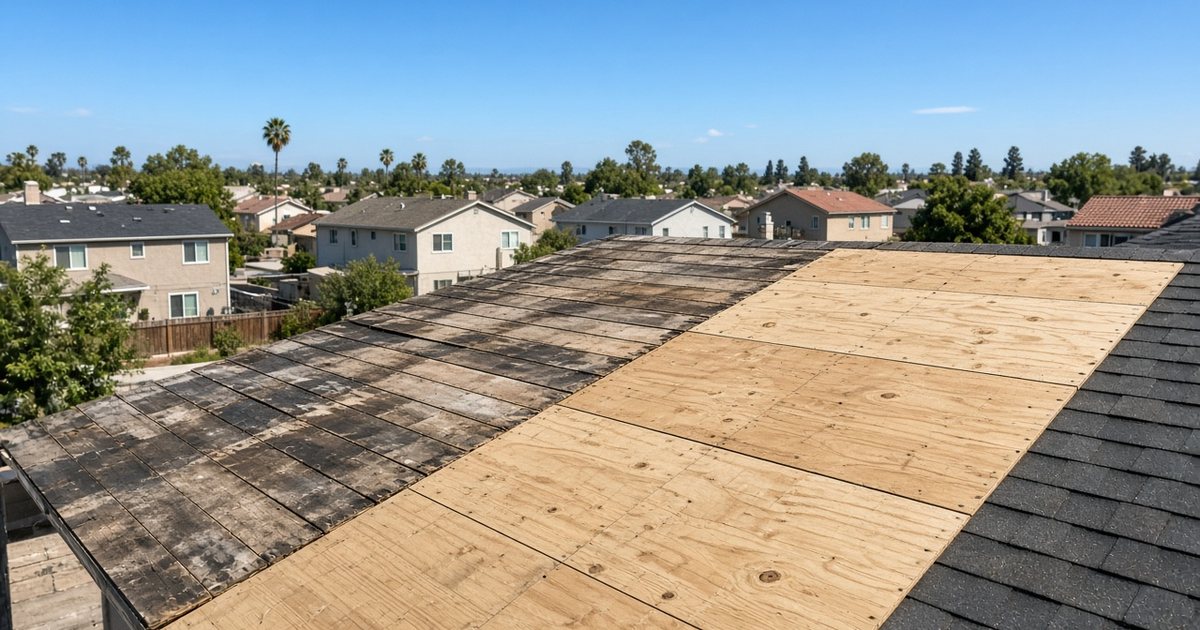
Halfway through tear-off day, your roofer calls: they found rotted wood under the old shingles, and some of the roof deck has to be replaced. It is one of the most common surprises in a California reroof, and one of the most common reasons a final bill ends up higher than the contract. Roof decking replacement is often necessary. How it is priced and approved is what you can control.
This guide explains what roof decking is, why dry rot happens, what to expect when it is found, and how per sheet allowances and change orders in your roofing contract keep the cost predictable.
What is roof decking?
The roof deck, also called sheathing, is the layer of wood boards or panels nailed to the rafters. Everything else sits on it: underlayment, flashing and the roof covering. It may be solid lumber boards or wood panels such as plywood or oriented strand board (OSB).
The deck matters for code, not just for comfort underfoot. Under California's residential code, asphalt shingles must be fastened to wood structural panels or solid lumber sheathing. A full roof replacement must remove the existing roof coverings down to the deck, which is exactly when hidden damage comes to light.
Source: 2025 California Residential Code §R905.2.1 and §R908.3 (effective January 1, 2026)
What causes dry rot in roof sheathing?
"Dry rot" is the everyday name for wood decay in the deck. On a roof, the moisture behind it usually comes from one of two places:
- Leaks from above. Failed flashing, worn shingles, clogged gutters and slow leaks around vents and skylights let water reach the wood, sometimes for years before a ceiling stain appears.
- Condensation from below. ARMA explains that warm, moist air from the house can condense on the underside of a cold roof deck and cause wood roof decks and structural members to rot. Proper attic ventilation removes that water vapor before it condenses.
Source: Asphalt Roofing Manufacturers Association, Residential Asphalt Roofing Manual (2014 edition), Chapter 3
If you are seeing the warning signs before a reroof, see roof ventilation and attic heat, how clogged gutters damage a roof and signs you need a new roof.
What it means when the roofer finds rotted decking
Rotted decking is not a reason to panic, but it is a reason to act. A deck that is soft or decayed cannot hold roofing nails properly. ARMA's guidance is that a deck that will not provide adequate anchorage for new roofing fasteners, or is not smooth and structurally sound, should be replaced. Depressions or sagging can point to deeper problems in the framing that also need attention.
Source: Asphalt Roofing Manufacturers Association, Residential Asphalt Roofing Manual (2014 edition), Chapter 13
The code adds a structural point: the roof framing has to support the new roof covering and the materials and equipment used during installation. If rot goes beyond the deck into rafters, the repair is bigger and may involve the building department.
Source: 2025 California Residential Code §R908.2
This is also why a roof overlay can hide trouble. A new layer over a rotted deck simply covers it, and the code does not allow a recover over a roof that is water soaked or too deteriorated to be a base. See roof repair vs replacement.
Source: 2025 California Residential Code §R908.4, Exception 1
How roof decking replacement is priced
Nobody can see the full condition of the deck until the old roof is off. Good contracts plan for that uncertainty in writing. You will usually see one of these approaches.
A per sheet price
The contract lists a unit price for each sheet of plywood or OSB replaced, and sometimes a separate price per linear foot for replacing individual boards. You only pay for what is actually replaced, at a price you agreed to before work started.
An allowance
The base price includes a set number of sheets, for example "includes up to X sheets of decking." Anything beyond that is billed at the stated unit price. Ask whether unused sheets are credited back to you.
Full redeck
On some older homes with spaced boards or widespread damage, the bid may include new sheathing over the whole roof. That makes the price more predictable, at a higher starting cost. A full redeck is also the easiest time to choose foil-faced sheathing; see radiant barriers in California attics.
Prices vary by region, material and access, so compare the unit prices across your bids rather than relying on a typical number. A bid that says "rotted wood extra" with no price is an open checkbook. See how to compare roofing bids and how much a new roof costs in California.
Change orders: your protection when rot is found
California law is specific here. A home improvement contract over $500, and any change to it, must be in writing and signed by both parties before the work covered by the change begins. The contract must also include a change order form, which becomes part of the contract only if it is written and signed before that work starts.
Source: California Business and Professions Code §7159(b), (c)(5) and (d)
The contract has to tell you that extra work or a change order is not enforceable against you unless, before the work begins, it identifies in writing the scope of the extra work, the amount added to or subtracted from the price, and the effect on progress payments or the completion date.
Source: California Business and Professions Code §7159(d)(13) and (e)(3)
In practice, when rotted decking turns up:
- Ask the crew to show you, or to send dated photos of the damaged areas before they are covered.
- Ask how many sheets or linear feet need replacing and at what unit price.
- Sign a written change order before the new wood goes on.
- Keep copies of the photos and the change order with your contract.
Read more in what should be in a roofing contract in California and how long a roof replacement takes.
Questions to ask before you sign
What is your price per sheet of decking, and per linear foot of board? How many sheets are included, if any? How will you show me the damage before you replace it? Will you use a written change order?
Also make sure the roofing contractor holds an active California contractor license from CSLB and is licensed and insured. See how to check a contractor's license in California.
Frequently asked questions
Can a roofer replace rotted decking without asking me?
California law requires changes to be in writing and signed before the work starts, and the change order has to state the scope, the price change and the effect on the schedule of payments or completion. If your contract sets a per sheet price, read how it says extra sheets are approved.
Is plywood or OSB better for roof decking?
Both are wood structural panels. Ask what the shingle manufacturer and your local building department accept for your roof.
Should I replace all the decking?
Not always. Sound decking can stay. A full redeck makes sense when damage is widespread or the existing boards are not a suitable base.
Does homeowners insurance pay for rotted decking?
It depends on your policy and on what caused the damage. Ask your insurer before you assume either way. See roof insurance claims in California.
Where ConFacts fits
A ConFacts report is a sourced background check on California C-39 roofing contractors built from public records, including CSLB license status, workers' comp, bond, the qualifier, certifications and reviews, scored from 0 to 100. Your first report is free, then $7, or 3 for $15. We take no money from contractors. We show you the record, you make the decision.
Two companies. Two reports.
Got more than one bid? Check them side by side, against the same records.
Compare bids side by side