What Is a Roofing Square? How to Read Your Bid
What a roofing square is, how pitch and waste factor change the count, and how to read the measurements on a California roofing bid before you sign.
Roofing bids are full of numbers that do not look like the square footage of your house: 24 squares, 6/12 pitch, 10 percent waste, 180 linear feet of drip edge. If you have ever wondered what is a roofing square and why your roof has more of them than you expected, you are not alone. These measurements drive the material order and much of the price.
This guide explains roofing squares, roof pitch and waste factor in plain English, and shows you how to read the measurements on a bid so you can compare roofers on the same footing.
What is a roofing square?
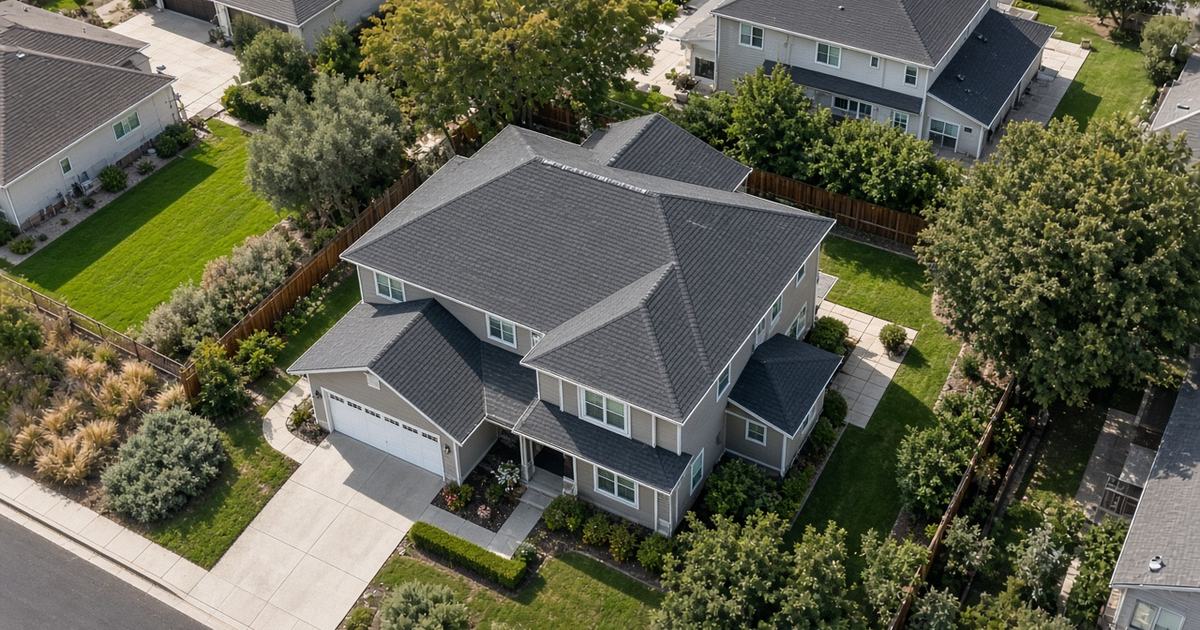
A roofing square is 100 square feet of roof surface, an area 10 feet by 10 feet. Roofers use it to figure out how much material to order, from underlayment to bundles of shingles. To get the number of squares, a roofer measures each plane of the roof, adds up the square footage and divides by 100. A roof measuring 2,500 square feet is 25 squares.
Source: GAF, "What Is a Roofing Square?"; Asphalt Roofing Manufacturers Association, Residential Asphalt Roofing Manual (2014 edition), Chapter 5
The key word is surface. Squares measure the sloped area of the roof itself, not the floor area of your home and not the flat footprint you would see on a map. That is why roof size and house size rarely match.
How many bundles are in a square?
Shingles come in bundles, sized so one person can carry them up a ladder. The number of bundles per square depends on the product. ARMA notes there are typically 3, 4 or 5 bundles per square. GAF says that for its Timberline HDZ shingles you can expect about three bundles per square.
Source: Asphalt Roofing Manufacturers Association, Residential Asphalt Roofing Manual (2014 edition), Glossary; GAF, "What Is a Roofing Square?"
So if two bids list different bundle counts for the same number of squares, they may simply be quoting different shingles. Ask which product each roofer is pricing.
How roof pitch changes the number of squares
Roof pitch, or slope, is the rise in inches for every 12 inches of horizontal run. A roof that rises 4 inches per foot has a 4 in 12 slope, written 4:12.
Source: Asphalt Roofing Manufacturers Association, Residential Asphalt Roofing Manual (2014 edition), Chapter 5
The steeper the roof, the more surface it has over the same footprint. This is geometry, not an estimate. The surface of a sloped plane is its flat footprint multiplied by the square root of 1 plus the slope squared. For common pitches, that works out to:
| Pitch | Roof surface compared with flat footprint |
|---|---|
| 4:12 | About 5% more |
| 6:12 | About 12% more |
| 8:12 | About 20% more |
| 12:12 | About 41% more |
Source: ConFacts calculation from the slope ratio, footprint × √(1 + (rise ÷ 12)²)
Pitch matters for more than area. Under California's residential code, asphalt shingles may be used only on slopes of 2:12 or steeper, and slopes from 2:12 up to 4:12 require a double layer of underlayment. GAF also notes that a contractor may adjust charges for the complexity and pitch of a roof.
Source: 2025 California Residential Code §R905.2.2 (effective January 1, 2026); GAF, "What Is a Roofing Square?"
What is a waste factor?
Shingles have to be cut at valleys, hips, rakes and around vents and chimneys. Those offcuts are waste, so roofers order more material than the measured area. ARMA says most roofing jobs need anywhere from 2% to 10% extra shingles for trim waste, depending on how many valleys, dormers, hips and roof penetrations there are.
Source: Asphalt Roofing Manufacturers Association, Residential Asphalt Roofing Manual (2014 edition), Chapter 5
A simple gable roof with two planes sits at the low end. A cut-up roof with several dormers and valleys sits at the high end. If a bid uses a much larger waste factor than the roof's shape seems to call for, ask why. If it uses none at all, ask how the roofer will cover the cuts.
How to read the measurements on a roofing bid
A detailed bid often has two kinds of numbers.
Area, in squares
- Measured squares: the roof surface itself. This is the number to compare between bids. If two roofers measured the same roof, their numbers should be close.
- Squares with waste: the measured area plus the waste factor. This drives the shingle order.
Lengths, in linear feet
ARMA notes that starter strips, drip edge, hip and ridge shingles, valley flashing and ventilation accessories are estimated from the lengths of the eaves, rakes, hips, ridges and valleys. You may see these listed separately.
Source: Asphalt Roofing Manufacturers Association, Residential Asphalt Roofing Manual (2014 edition), Chapter 5
- Eaves and rakes: the roof edges, where drip edge and starter go.
- Ridges and hips: the peaks and outside corners, where cap shingles go.
- Valleys: the inside corners, which need valley lining or flashing.
If you want a refresher on those parts, see roof underlayment explained and roof ventilation and attic heat.
A worked example
Say the roof covers a flat footprint of 2,000 square feet at a 6:12 pitch. Multiply by about 1.12 and the roof surface is roughly 2,240 square feet, or about 22.4 squares. Add a 10% waste factor and the order is about 24.6 squares. At three bundles per square, that is roughly 74 bundles of shingles. The numbers here are arithmetic, not a quote; your roofer's measurements of your own roof are what count. Check that each step on the bid follows from the one before it.
Red flags in roof measurements
- A bid with a lump sum price and no measurements at all.
- One bid that is several squares higher or lower than the others for the same house.
- A price per square with no statement of what it includes, such as tear-off, underlayment, flashing and disposal.
- A waste factor that is not explained, or is counted twice alongside separate line items.
Measurements are only part of a fair comparison. See how to compare roofing bids and how much a new roof costs in California.
Questions to ask the roofer
How did you measure my roof? How many squares is the roof itself, and what waste factor did you add? Which shingle are you pricing, and how many bundles per square does it take? What is included in your price per square?
Get the answers in writing before you sign, and make sure the roofing contractor holds an active California contractor license from CSLB and is licensed and insured. See questions to ask a roofer before hiring.
Frequently asked questions
How many squares is a 2,000 square foot house?
It depends on the roof, not the floor area. Overhangs, pitch and the number of stories all change the answer, which is why a roofer measures each plane.
Why is my roof bigger than my house?
Because squares measure the sloped roof surface, and the roof usually extends past the walls. A 6:12 roof also has about 12% more surface than its flat footprint.
Do roofers charge by the square?
Many bids are built from a price per square plus line items. Ask what the per square price includes so you can compare bids fairly.
Is the waste factor a hidden fee?
No. It covers real offcuts. It should match the shape of your roof and be stated clearly.
Where ConFacts fits
Accurate measurements come from a roofer you can trust. A ConFacts report is a sourced background check on California C-39 roofing contractors built from public records, including CSLB license status, workers' comp, bond, the qualifier, certifications and reviews, scored from 0 to 100. Your first report is free, then $7, or 3 for $15. We take no money from contractors. We show you the record, you make the decision.
Two companies. Two reports.
Got more than one bid? Check them side by side, against the same records.
Compare bids side by side