Roof Underlayment Explained for Homeowners
What roof underlayment is, how felt compares with synthetic, why it matters on a California reroof, and what to ask a roofer before you sign.
The shingles, tile or metal you see from the street get all the attention. Underneath them is a layer most homeowners never look at: the underlayment. On a new roof, it is one of the details that decides whether wind-driven rain stays out or finds the wood deck. This guide explains what roof underlayment is, how felt compares with synthetic and self-adhering membranes, what California's residential code requires, and the questions to ask a roofer before you sign.
What is roof underlayment?
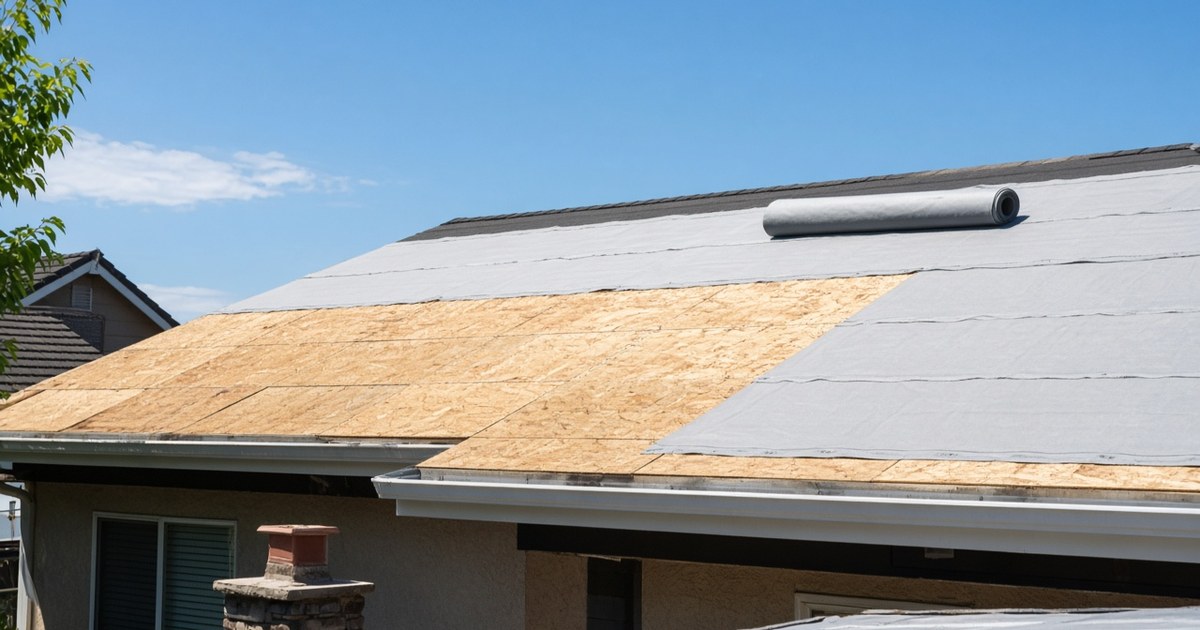
Roof underlayment is the sheet material fastened or stuck to the roof deck before the finished covering goes on. Asphalt shingles should not be installed directly on a wood deck. The underlayment sits between the wood and the shingles, tile or metal and gives the roof a second water-shedding layer.
Source: Asphalt Roofing Manufacturers Association, "Steep Slope Roofing Underlayment"
The finished roof is the first defense. The underlayment is there when wind drives rain under a shingle, when a valley concentrates water, or when the covering is not yet in place during a reroof.
Why underlayment matters
A careful underlayment job does several things at once:
- It sheds water that gets past the covering, so less of it reaches the deck.
- It keeps the deck drier during the job, until the new covering is on.
- It is a required part of a fire-classified roof assembly, which matters in California.
- It can hide slight differences in deck thickness so the finished roof looks smoother.
Source: Asphalt Roofing Manufacturers Association, "Steep Slope Roofing Underlayment"
On a tile roof, this layer matters even more. Tile is the wear surface. The underlayment is often what actually keeps water out. Tiles that still look fine can hide underlayment that has dried out or torn. See roof repair vs replacement and tile vs shingle vs metal in California. Our guide to tile roof underlayment replacement explains when it is time.
Felt vs synthetic vs self-adhering
You will usually hear about three families of product. The right choice depends on the covering, the slope, the climate and what the manufacturer requires for the warranty.
| Type | What it is | Common standard |
|---|---|---|
| Asphalt felt | Asphalt-saturated organic felt. Type I is commonly called No. 15 felt. The heavier Type II is often called No. 30 felt. Use the non-perforated kind under shingles. | ASTM D226 or ASTM D4869 |
| Synthetic underlayment | A polymeric sheet, usually lighter than felt, with more coverage per roll. | ASTM D8257 |
| Self-adhering membrane | A sticky, polymer-modified sheet that seals around nail shanks. Often used at eaves, valleys, hips, ridges and around vents, chimneys and skylights. | ASTM D1970 |
Source: Asphalt Roofing Manufacturers Association, "Steep Slope Roofing Underlayment"
Felt has a long track record and is still allowed under the code for many coverings. It can wrinkle if it gets wet and then dries, and it is easier to tear than many synthetics. Synthetic underlayment is now common on California reroofs because it is lighter to handle and holds up better if the deck is open for a day. Self-adhering membrane, often called ice and water shield, is the specialist at valleys, eaves and penetrations, and it can also be used over the whole deck when the code and the manufacturer allow it.
If a self-adhering membrane covers the entire deck, ventilation becomes more important, because that membrane acts as a vapor retarder. Poor ventilation can trap moisture under the deck. See roof ventilation and attic heat.
Source: Asphalt Roofing Manufacturers Association, "Steep Slope Roofing Underlayment"
What does California's residential code require?
The 2025 California Residential Code, effective January 1, 2026, requires underlayment under asphalt shingles, clay and concrete tile, metal roof shingles and panels, slate, wood shingles and shakes, roll roofing and building-integrated photovoltaic coverings. The product must bear a label showing it meets the standard in the code tables, such as ASTM D226, D1970, D4869 or D8257.
Source: 2025 California Residential Code §R905.1.1 and Table R905.1.1(1) (effective January 1, 2026)
How many layers you need depends mainly on slope. For asphalt shingles in areas where special wind design is not required:
- From a 2:12 slope up to 4:12, the code calls for two layers of underlayment, lapped in a specific way, or a single layer of self-adhering membrane that meets ASTM D1970.
- At 4:12 or steeper, one layer is the usual requirement, applied shingle fashion and lapped 2 inches, with 4-inch end laps offset by 6 feet. A single layer of ASTM D1970 membrane is also allowed.
Asphalt shingles may not go on a slope below 2:12. On low slopes, the double layer is there because water moves more slowly and is more likely to back up under the shingles. Not sure of your slope? See how to find your roof pitch.
Source: 2025 California Residential Code §R905.1.1, Table R905.1.1(2) and §R905.2.2
An ice barrier (two cemented layers of underlayment, or a self-adhering polymer-modified bitumen sheet) is required only where the jurisdiction's Table R301.2 shows a history of ice forming along the eaves. It must run from the lowest roof edge to at least 24 inches inside the exterior wall line, or 36 inches along the slope on roofs of 8:12 or steeper. Much of coastal and low-elevation California will not have that designation. Mountain areas might. Your building department decides. Even where an ice barrier is not required, many roofing contractors still use self-adhering membrane in valleys and around penetrations, which the manufacturers' association describes as excellent secondary protection at those details.
Source: 2025 California Residential Code §R905.1.2; Asphalt Roofing Manufacturers Association, "Steep Slope Roofing Underlayment"
At a shingle roof edge, underlayment goes over the drip edge along the eaves and under the drip edge along the rakes.
Source: 2025 California Residential Code §R905.2.8.5
A re-roof should come with a permit, and some cities inspect the deck after tear-off and check underlayment and flashing at the final inspection. See do you need a permit to replace a roof in California.
What should you ask your roofer?
Underlayment is easy to hide in a bid that only names the shingle brand. Put it in the contract. California home improvement contracts over $500 have to describe the significant materials to be used. See what should be in a roofing contract and how to compare roofing bids.
"What underlayment product will you install, which ASTM standard does it meet, and where will you use self-adhering membrane?"
Ask, in writing:
- The brand and product name, and whether it is felt, synthetic or self-adhering.
- The ASTM standard on the label, and how many layers your slope requires.
- Where self-adhering membrane will be used: eaves, valleys, hips, skylights, sidewalls, vents and chimneys.
- Whether the shingle, tile or metal manufacturer's instructions require a particular underlayment for the warranty you are being offered.
- Whether the underlayment will be visible at a deck or in-progress inspection before the covering goes on.
Before you sign, confirm the roofing contractor holds a California contractor license with a C-39 classification, and that the company is licensed and insured. Look the license up on the CSLB website. See how to check a contractor's license in California and questions to ask a roofer before hiring.
Frequently asked questions
Is synthetic underlayment better than felt?
Not automatically. Both can meet the code if they are the right ASTM type for the covering and the slope. Compare the label, the manufacturer's instructions and the installation, not just the name.
Do I need ice and water shield in California?
An ice barrier is required only where your jurisdiction's code tables show a history of ice at the eaves. Many roofers still use self-adhering membrane in valleys and around penetrations as extra protection. Ask what your city requires and what the bid includes.
Can I skip underlayment to save money?
You should not. The California Residential Code requires it for the common steep-slope coverings, and manufacturers treat it as part of a complete roof system.
Will I see the underlayment after the job?
Usually no, which is why you want the product named in the contract and checked at inspection where the city allows it.
Where ConFacts fits
The underlayment is only as good as the roofing contractor who installs it. A ConFacts report builds a sourced background check on California C-39 roofing contractors from public records, including CSLB license status, workers' comp, bond and disciplinary history, and scores them from 0 to 100. Your first report is free, then $7, or 3 for $15. We take no money from contractors. We show you the record, you make the decision.
Two companies. Two reports.
Got more than one bid? Check them side by side, against the same records.
Compare bids side by side