Earthquake Retrofit in California: Brace and Bolt
What a brace and bolt earthquake retrofit is, which older California homes need one, how the Brace + Bolt grant works, and how to hire a contractor.
If you own an older California house that sits up off the ground on a crawl space, an earthquake retrofit may be one of the most useful projects you can do. It is not glamorous work. Nobody sees it once it is done. But it targets one of the most common ways older wood frame homes get damaged in earthquakes. This guide explains what a brace and bolt earthquake retrofit is, which homes need one, how the state's Earthquake Brace + Bolt grant works, and how to hire a contractor for it.
What is an earthquake retrofit?
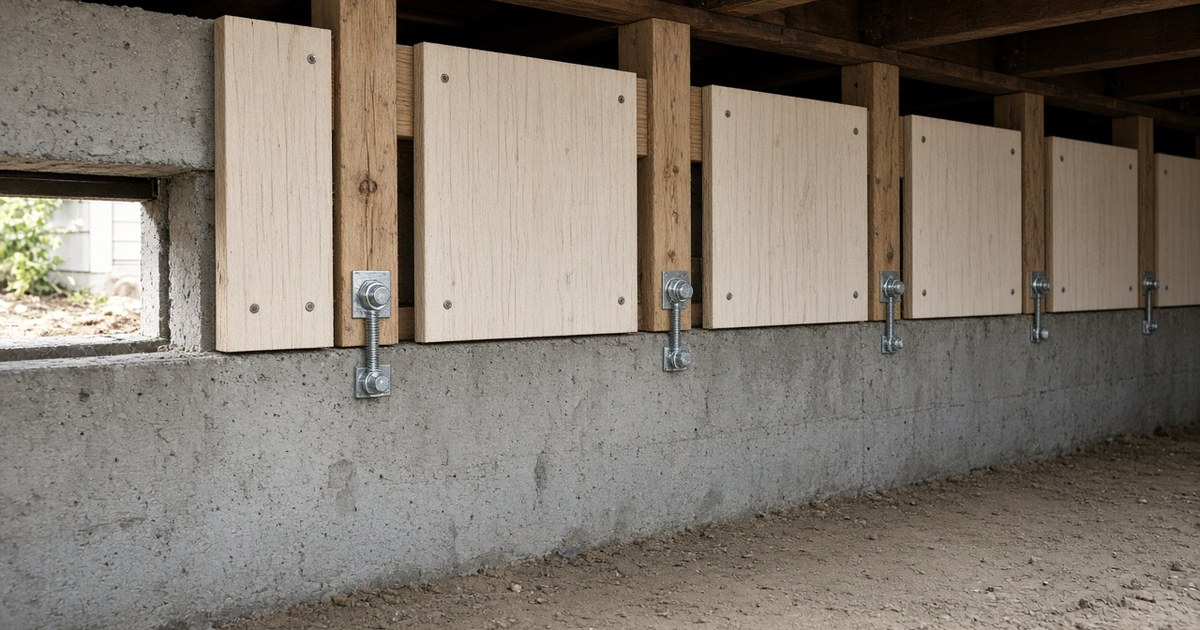
A seismic retrofit strengthens an existing house so it better resists earthquakes. For many California homes, the standard version is called "brace and bolt." According to the California Residential Mitigation Program, which runs the Earthquake Brace + Bolt (EBB) program, the retrofit bolts the house's wood frame to its foundation and, where there are short walls called cripple walls in the crawl space, braces those walls with plywood. The goal is to help keep the house from sliding or toppling off its foundation in an earthquake.
Source: Earthquake Brace + Bolt (California Residential Mitigation Program), "The Earthquake Brace + Bolt Retrofit," earthquakebracebolt.com
The three parts of the work
- Bracing cripple walls. Cripple walls are short walls, 4 feet or less, between the floor of the house and the foundation. They carry the weight of the house. Plywood or OSB sheathing is attached to strengthen them.
- Bolting. Anchor bolts or foundation plates connect the wood frame to the concrete foundation. The EBB program says most earthquake damage occurs when unsecured buildings slide off their foundations.
- Strapping the water heater. EBB requires the water heater to be properly strapped and braced, because water heaters that move or tip can break gas and water lines.
If your house sits directly on a foundation stem wall with no cripple walls, it may only need a "bolt-only" retrofit.
Source: Earthquake Brace + Bolt, "The Earthquake Brace + Bolt Retrofit," earthquakebracebolt.com
Does my house need a seismic retrofit?
The EBB retrofit is only done on wood framed houses built before 1980 with a raised foundation.
Source: Earthquake Brace + Bolt, earthquakebracebolt.com (eligibility description)
What counts as a raised foundation? The CEA describes it as a house with an area under the floor, often called a crawl space, raised off the ground by supports such as cripple walls, a continuous concrete stem wall, posts and piers, or unreinforced masonry or concrete block. Water heaters have their own earthquake strapping rules; see our guide to water heater replacement permits.
Source: California Earthquake Authority, "Get a Discount" page, foundation types
Homes on a concrete slab at ground level are a different story. The California Earthquake Authority (CEA) says slab foundation houses are already more earthquake resistant, and its premiums already reflect that.
Source: California Earthquake Authority, "Get a Discount" page, earthquakeauthority.com
If you are not sure what you have, a contractor or engineer can look in the crawl space and tell you.
What does an earthquake retrofit cost?
The EBB program says a typical retrofit by a licensed contractor may cost between $3,000 and $7,000, depending on the location and size of the house, contractor fees, and the amount of materials and work. Some foundations need more extensive work that raises the cost. A do it yourself retrofit can cost less than $3,000.
Source: Earthquake Brace + Bolt, "How Much Does a Typical Retrofit Cost?," earthquakebracebolt.com
How the Earthquake Brace + Bolt grant works
EBB offers grants of up to $3,000 toward a qualifying retrofit. Income eligible homeowners can also apply for an additional grant of up to $7,000; on the day we checked, the program listed that threshold as a yearly household income of $94,480 or less.
Source: Earthquake Brace + Bolt, earthquakebracebolt.com, checked November 19, 2026
A few things to know:
- Registration opens for a limited time each year. You register online and answer questions about your house, and your answers determine whether it qualifies.
- It is limited to certain ZIP codes. The program says that as of January 15, 2025, EBB is offered in over 1,100 high hazard ZIP codes, chosen partly by the share of older houses in each area. Check the program's ZIP code list for yours.
- You must use a listed contractor if you hire one. Contractors in the EBB Contractor Directory are FEMA trained in seismic retrofitting and are California licensed general contractors.
- The work must meet the code. An EBB retrofit must comply with the California Existing Building Code, Chapter A3, which covers light wood frame houses.
Source: Earthquake Brace + Bolt, program description and FAQ, earthquakebracebolt.com
Experienced do it yourselfers can do the retrofit as an owner-builder, but the program notes that the value of your own labor is not a recoverable cost.
Source: Earthquake Brace + Bolt, "Who Can I Hire to Complete the Retrofit?," earthquakebracebolt.com
Other savings: insurance and property taxes
Earthquake insurance discount
If you have a CEA earthquake policy, a retrofit can lower your premium. The CEA offers up to a 25 percent discount for qualifying one to four unit, wood framed homes built before 1980 that have been retrofitted to California standards and have a properly secured water heater.
| Foundation type | Built 1940 to 1979 | Built 1939 or earlier |
|---|---|---|
| Raised foundation | 20% discount | 25% discount |
| Other (non-slab) foundation | 10% discount | 15% discount |
Source: California Earthquake Authority, "Get a Discount" page, earthquakeauthority.com
For other insurance questions tied to your house, such as how insurers look at your roof, see our guide to roof age and home insurance in California.
Property tax exclusion
The State Board of Equalization lists seismic safety retrofitting improvements as a new construction exclusion under Revenue and Taxation Code section 74.5. To claim it, notify the assessor of your intent within 30 days of completion and file documents within six months.
Source: California State Board of Equalization, "New Construction" property tax page
We explain how California treats home improvements in our guide on whether a new roof increases property taxes in California.
How to hire an earthquake retrofit contractor
- Check the license. Confirm the license is active on the CSLB website. Here is how to check a contractor's license in California.
- Check the classification. EBB directory contractors are licensed general contractors. Read what a B general building contractor license allows.
- Check the bond. See contractor license bonds in California.
- Get a written scope. The contract should say whether the work is brace and bolt or bolt only, the number and type of anchors, how much wall will be braced, the water heater strapping, and who handles the permit and inspection with your building department.
- Watch the deposit. California caps down payments on home improvement contracts. Our guide to how much a contractor can ask for a deposit in California explains the limit.
Frequently asked questions
Is an earthquake retrofit worth it?
For an older wood frame house on a raised foundation, it addresses a known weak point at a cost the EBB program puts at roughly $3,000 to $7,000 for a typical job, and grants and insurance discounts may offset part of that.
Do newer homes need a brace and bolt retrofit?
EBB limits the program to houses built before 1980. Ask your building department or an engineer about newer homes.
Can I do the retrofit myself?
Yes, as an owner-builder, but the work still has to meet California Existing Building Code Chapter A3.
Retrofit and reroof on the same house?
Many older homes need both. If a roofing contractor is part of your plans, a ConFacts roofing contractor check gives you a sourced background check on California C-39 roofers built from public records, including CSLB license status, workers' comp, bond, the qualifier, certifications and reviews, with a 0 to 100 Trust Score. Your first report is free, then $7, or 3 for $15. We take no money from contractors. We show you the record, you make the decision.
Two companies. Two reports.
Got more than one bid? Check them side by side, against the same records.
Compare bids side by side