Roof Flashing Explained: Types, Leaks and Repair
What roof flashing is, the main types from chimney flashing to drip edge, the signs it has failed, and when a flashing repair beats a full reroof.
Most roof leaks do not start in the middle of a slope. They start where the roof meets something else: a chimney, a wall, a valley, a vent pipe or the edge of the roof. That is where roof flashing does its job, and where it fails first. This guide gives you roof flashing explained in plain English: what it is, the types you will see on a bid, the signs of failed flashing, and how to decide between a flashing repair and a full reroof.
What is roof flashing?
Flashing is the thin material, usually sheet metal, that bridges the joints a roof covering cannot seal on its own. The Asphalt Roofing Manufacturers Association describes it as one or more thin layers of sheet metal placed between the roofing and a wall or protrusion to steer water toward gutters and drains and away from the inside of the house. Wherever a roof plane meets another surface or is pierced by something, flashing is essential for a roof that does not leak.
Source: Asphalt Roofing Manufacturers Association, Residential Asphalt Roofing Manual (2014 edition), Chapter 10
California's residential code says the same thing in legal terms. Flashing must be installed so it keeps moisture from entering the wall and roof at joints, at intersections with walls and at other penetrations through the roof. It is required at wall and roof intersections, wherever the roof changes slope or direction, and around roof openings. Metal flashing must be corrosion resistant and at least 0.019 inch thick (No. 26 galvanized sheet).
Source: 2025 California Residential Code §R903.2 and §R903.2.1 (effective January 1, 2026)
The types of roof flashing on a California home
Chimney flashing
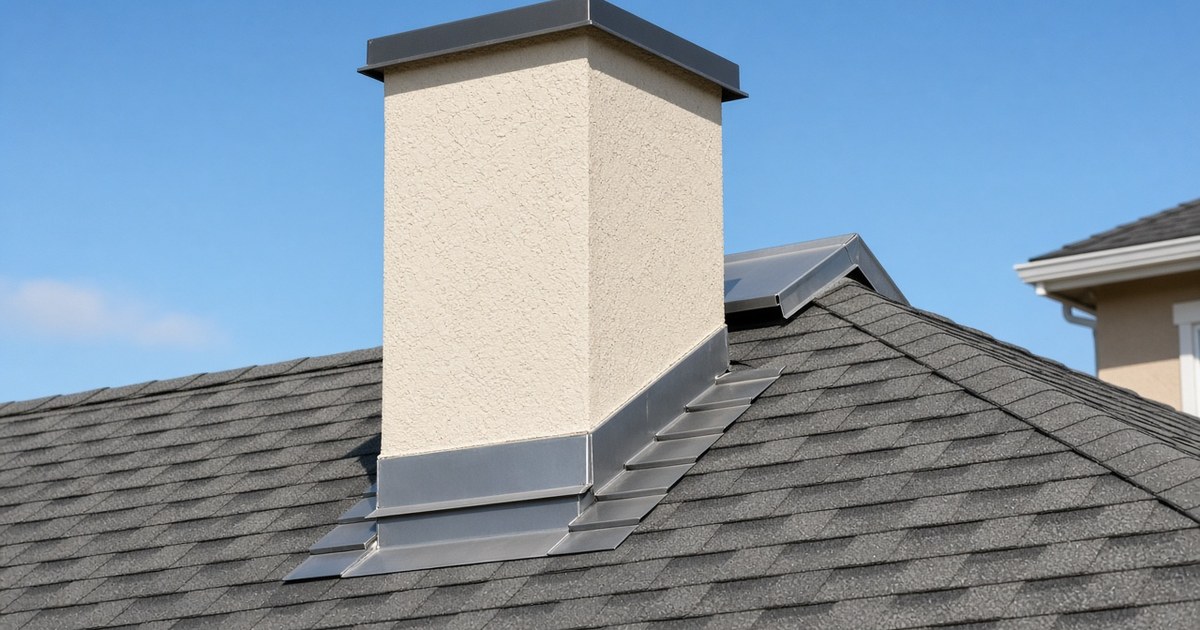
A chimney needs a set of pieces: an apron across the front, step flashing up the sides, and flashing behind it, with counterflashing set into the masonry so it laps over the lower pieces. The two layers let the house and the chimney move without opening a gap. The code also requires a cricket or saddle, a small peaked diverter, on the uphill side of any chimney or penetration wider than 30 inches across the slope.
Source: Asphalt Roofing Manufacturers Association, Residential Asphalt Roofing Manual (2014 edition), Chapter 10; 2025 California Residential Code §R903.2.2
Step flashing and wall flashing
Where a roof slope runs into a sidewall, such as a second story or a dormer, small bent pieces of metal are woven in with each course of shingles. That is step flashing. On a shingle roof, the code calls for sidewall base flashing that is continuous or step flashing, at least 4 inches tall and 4 inches wide, that sends water onto the roof or into the gutter. Where there is siding, the flashing has to run up under it.
Source: 2025 California Residential Code §R905.2.8.3
A related detail, often called kickout flashing, sits where the bottom of a sloped roof meets a wall. The code requires flashing there to divert water away from the wall. When that piece is missing, water can run into the wall and show up as a stain far from the roof.
Source: 2025 California Residential Code §R903.2.1
Valley flashing
A valley is where two roof slopes meet in a trough. It carries more water than any other part of the roof. The code allows open valleys lined with corrosion resistant metal at least 24 inches wide, or closed valleys with an approved lining under the shingles, installed per the manufacturer's instructions.
Source: 2025 California Residential Code §R905.2.8.2
Vent boots and pipe flashing
Every plumbing vent and exhaust pipe through the roof needs a flashing collar, often called a pipe boot or pipe jack. On a shingle roof, vent pipe, soil stack and chimney flashing must be applied following the shingle manufacturer's instructions. On older roofs, a cracked collar is a common leak point.
Source: 2025 California Residential Code §R905.2.8.4
Drip edge
Drip edge is the metal strip along the eaves and rakes. It guides water off the roof edge and protects the edge of the deck. The code requires drip edge at the eaves and rake edges of shingle roofs, lapped at least 2 inches, extending at least 1/4 inch below the sheathing and at least 2 inches back onto the deck, nailed no more than 12 inches apart.
Source: 2025 California Residential Code §R905.2.8.5
Why failed flashing causes roof leaks
Shingles and tiles shed water by overlapping. They work well on an open slope. They cannot seal a vertical joint against a chimney or a wall, so that joint depends entirely on flashing. When flashing rusts through, pulls loose, gets bent by foot traffic or is covered over with caulk instead of being replaced, water gets behind the roof covering. It can travel along a rafter or inside a wall before it shows.
That is why a ceiling stain is not always under the source. If you are dealing with an active leak, start with what to do when your roof is leaking in the rain. Skylights have their own flashing kit and their own failure points, covered in why skylights leak.
Signs your roof flashing has failed
- Water stains on a ceiling or wall near a chimney, skylight, dormer or second story wall.
- Rust, holes or lifted edges on metal you can see from the ground with binoculars.
- Thick beads of roofing cement or caulk smeared over joints, a sign of past patches.
- Cracked rubber on pipe boots, or gaps where a vent meets the roof.
- Stained or soft wood at the eaves, which can point to a missing or damaged drip edge.
None of these is proof on its own. They are reasons to have a licensed roofer look closely. See when to get a roof inspection in California.
Roof flashing repair vs reroof
Flashing problems are often fixable without a new roof. A cracked pipe boot or a loose piece of step flashing can usually be repaired if the roof around it is sound.
When a flashing repair makes sense
- The roof covering is in good shape with years of life left.
- The leak traces to one location, such as one vent or one side of a chimney.
- The roofer can replace the flashing and reweave the roofing around it cleanly.
When a reroof may be the better call
- Several flashings are failing at once, or the same leak keeps returning after repairs.
- The shingles around the flashing are brittle and will break when lifted.
- The roof is old enough that you would pay to disturb it twice.
If you do reroof, ask how flashing will be handled. The asphalt roofing manual advises replacing worn flashings before reroofing, and the code says flashings must be reconstructed according to the manufacturer's instructions, with existing flashings and vents that are rusted, damaged or deteriorated replaced when tile or slate is reinstalled. For more, see roof repair vs replacement and signs you need a new roof.
Source: Asphalt Roofing Manufacturers Association, Residential Asphalt Roofing Manual (2014 edition), Chapter 13; 2025 California Residential Code §R908.5 and §R908.6
What to ask before you sign
A bid that just says "flashing as needed" leaves you guessing. Ask the roofing contractor to answer in writing:
Which flashings will you replace, which will you reuse, and why? Will the chimney get new counterflashing? Is new drip edge included at the eaves and rakes?
Also confirm the basics. The contractor should hold an active California contractor license from CSLB in the right classification, usually C-39 roofing, and be licensed and insured. See how to check a contractor's license in California, how to compare roofing bids and roof underlayment explained.
Frequently asked questions
Can a roofer reuse old flashing on a new roof?
Sometimes, if it is in good condition and the manufacturer's instructions allow it. Rusted, damaged or bent flashing should be replaced. Ask which pieces are being reused and why.
Is caulk a substitute for flashing?
No. Sealant can help at some details, but it is not a replacement for properly lapped metal that sheds water on its own.
How do I know if a leak is from flashing or the shingles?
Location is the best clue. Leaks near chimneys, walls, valleys, vents and skylights often trace back to flashing. A roofer should be able to show you photos of what they found.
Where ConFacts fits
Good flashing work depends on who does it. A ConFacts report is a sourced background check on California C-39 roofing contractors built from public records, including CSLB license status, workers' comp, bond, the qualifier, certifications and reviews, scored from 0 to 100. Your first report is free, then $7, or 3 for $15. We take no money from contractors. We show you the record, you make the decision.
Two companies. Two reports.
Got more than one bid? Check them side by side, against the same records.
Compare bids side by side